Become A Successful Author

Keep your focus: Increase quality, credibility and visibility of your brand.

When A Writer Doesn’t Write by Deatri King-Bey

DeatriThere are times that months go by that I don’t write one word toward a manuscript, outline, research or anything for my future titles. The first time I did this, my family became worried, talked about “writer’s block” and plotted on how to break me out of it.

I kept explaining that I didn’t have writer’s block. I just didn’t feel like writing.  Shooooot, truth be told, I could use a good dose of writer’s block at times. Maybe that would make the characters in my mind be quiet. <SMILE>.  Back to the family and the case of writer’s block. Three weeks in, they decided I must be depressed and that’s why I had writer’s block. I’m lucky I didn’t get locked up, y’all. I was tempted to write something for pleasure (actually pressure because they were pressuring me) to keep them from sending me to the padded room on the psych ward.

I was not under any quick approaching deadline with a publishing house. I was free and enjoying it. I could write—and I thought NOT WRITE—at my own pace. I go through phases. At times I’ll write every free second I can squeeze out of the day and create extra seconds to write some more. Other times I’m happy with the two hours I set aside a day. Then there are times when I don’t want to write at all. I may go days or even weeks without writing a word. Note to self—never Ever EVER allow family to find out you’re in the no-writing phase.

I absolutely LOVE my no-writing phase. When I’m in it, I read like nobodies business. I’m talking a book a day (and don’t forget the full time job, children, husband, pets, grandbaby who most think is my son, volunteer work…) I’m up all night and going to work sleepy, but I don’t even care.

When I write, the stories come easily for me, but all of that creativity is draining in ways that are hard to explain. The no-writing phase keeps me from experiencing creative burn-out, which will lead to writer’s block. I become a creativity vampire ready to take a bite of the next novel. My no-writing phase rejuvenates me by overfilling my creative cup.

So if you haven’t heard from me in a while, could one of you please check the psych ward for me, because my family just doesn’t get it <WINK>.

So let’s look at the other side. What if you actually do have writer’s block.

“Oh no! My characters have stopped talking to me, and I have no idea what to write next. It’s just not coming to me. I’ll never finish this book.” –Author with writer’s block.

First, do you actually have writer’s block or do you just not feel like writing? As I explained above, there is a difference. I know there are those out there who believe you must write every day, but my creative self, my muse would be very unhappy with me if I forced it to work daily without giving it a break every so often, and it doesn’t matter that my muse loves what it does. In my opinion, overworking the muse can cause it to go on strike and leave you with writer’s block.

So let’s say you actually do have writer’s block. How can you get out of it? You’ll need to see what works for you.

  • Take a break: Go do something enjoyable that doesn’t include writing. Some have found it helpful to take a vacation from writing with an end date they’ve set, then find themselves craving to write before the end date arrives.
  • Freewriting: Write or type whatever comes to your mind without form or reason. Just write. It doesn’t have to make sense, have a format, follow the rules of grammar…
  • Read books in the genre you are writing.
  • Read books in any genre except the one you are writing.
  • Talk the plot point out with someone, brainstorm through the issue.
  • Ensure you aren’t trying to FORCE the plot to places you want it to go instead of where it should logically go. The muse fights back and the next thing you know, you have writer’s block and/or a clunky plot.
  • Step away from your current work in progress for a day or two then begin reading it from page one.
  • Work on your marketing plan for the novel or some other aspect of the novel. Do some research, conduct an interview. How is the Website looking?
  • Stop forcing the creativity if you don’t want it to revolt.

Much Joy Peace and Love

Deatri King-Bey

If you found this post helpful, please use the Share buttons to spread the word about it.


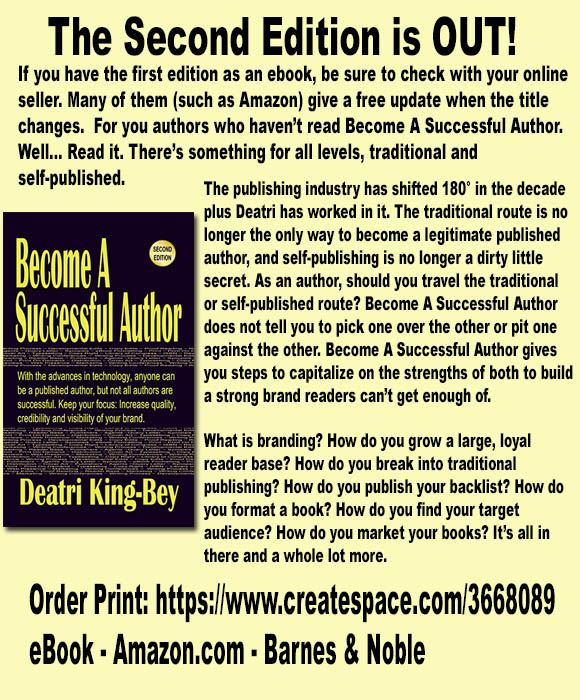
Don’t have a copy of Become A Successful Author? What are you waiting for?Become A Successful Author is used in the “How To Write That Novel” course at Chicago State because it covers everything from branding to writing to editing to formatting and uploading electronic and print books to marketing and so much more. Your time is money. Look at all the time, thus money, you’ll save by ending your search for answers: Purchase Become A Successful Author for only $4.99 (eBook) or$9.99(print) from: Amazon (US), Amazon (UK), Barnes & Noble

Share

How to Promote When You Write in a Niche Market by Stacy-Deanne

Stacy-DeanneAs more authors grace the industry with their presence it can become difficult for an author to stand out. It is especially difficult for writers who write in niche markets. Believe me I know. My primary genre is mystery and suspense, which is one of the biggest selling genres, but my novels are also interracial. Interracial books sell well but they do not receive mainstream attention, and the interracial market is extremely limited compared to books in other markets.

Don’t worry. I’m here to help. Well, at least I wanna try to help. I’m not trying to give you advice on how to sell more books, but how to reach your audience. Selling books is a matter of hard work and a whole bunch of luck. Heck, sometimes you don’t even need to put in the hard work if you’re lucky for your book to take off right out the gate. The average author isn’t so lucky and will have to put in some minimum work to get the word out.

Below are some tips that can lead you to your target audience:

Target Facebook Groups

Wait a minute. I know you’re saying, “And what’s so new about that tip? I’m already busting my chops on Facebook.” Yes but are you busting your chops the right way? When I say Facebook groups, I don’t mean book groups, reading groups, or book clubs. No. I mean Facebook groups geared toward the subject of your book. I am talking about regular groups targeted to those with an interest in what you write. For example, there are many interracial dating groups on Facebook. Many of these groups are geared toward black women and white men couples, which is the interracial pairing I write about the most. I’ve been a valid member of many of these groups. I didn’t join just to sell books but because of the common interest I had with these people. The key is to become a part of the group, and not just promote your books. You don’t have to go to a book group or reading group to find readers. Readers are everywhere and if you write in a niche market, you have to be creative to get in touch with your audience.

Establish Your Niche as Your Brand

Do you write multicultural stories that take place in Southeast Asia? Do you write gay and lesbian books for the urban crowd? Do you write lesbian Chick Lit? Establishing your brand as an author is important anyway, but it’s a must if you write in a niche market. In order to stand out you need to make yourself look like an expert. Your niche needs to become your brand, and you need to make sure that wherever you go as an author, that niche follows along with you. Say you write gay and lesbian street lit books. The normal street lit crowd most likely aren’t interested in them, and the gay and lesbian crowd most likely won’t want to read street lit. You must get creative because your work doesn’t fit anywhere. You have to create a place for your niche to fit. Start a blog geared toward nothing but gay and lesbian issues in the urban community. Write articles geared toward the gay and lesbian street crowd. Start an Internet radio show where you discuss how being gay fits into the street community. No matter what you do and where you go, you need to become the poster child for what you write. Niche authors do not have a choice.

Write for Online Magazines and Sites

There are online magazines and sites geared toward all types of subjects. You’re bound to find something that fits your niche. Once you do, read the magazine (if you don’t already) and become familiar with the things they feature. Pitch articles or blogs to the magazine or site. You might end up with a regular gig, but even if you’re just featured in the magazine or on the site you will gain credibility through the subject you write about. When you write about things pertaining to your niche, you’re putting yourself out there for readers interested in your work. Many readers who read magazines or articles on sites check out the authors who’ve written the piece. It’s a solid road to getting your book into your targeted readers’ hands.

Start Your Own Magazine

No I’m serious. Did you know that you could start your own online magazine free? There are sites that provide you with free magazine templates and will even send out the magazines to subscribers free. Some have the option of print magazines and some only online magazines. You can start a magazine geared toward your niche. You can feature other writers and people who share your interest. If you stick to it, you might have a popular magazine one day. It might seem unbelievable but many online magazines started as simple sites.

Join a Cause

Are there any groups or organizations that focus on what you write? Do you write romances featuring plus-sized women? There are many Fat Acceptance groups to join and this is a great way to establish your brand. Your readership is most likely heavyset women who wanna read romances that feature women like them so joining groups they are interested in will alert them of your books and they’ll buy to support you. Do you write graphic novels featuring superheroes with disabilities? If you write characters with disabilities then consider working for disability organizations. They will embrace you and appreciate the fact that you feature disabled people in your books. You might also get offers for people to sponsor your book and help you spread the word. The best part though is to join these organizations because you honestly want to help. Never join something just to get book sales. Disabled people deserve the support of the community so if you decide to join a group, be there for the cause and not just to sell books.

You have to get creative. You can’t just throw a niche book out into the world and promote it like a mainstream book. That won’t work. You also have to accept that your audience might be limited so have realistic expectations. If you write books in an extremely small niche then you might not sell over a certain amount of books no matter what you do. Some niche books however do have a large market of readers, but reaching them is the key. The possibilities are endless.

Stacy-Deane

If you found this post helpful, please use the Share buttons to spread the word about it.


Don’t have a copy of Become A Successful Author? What are you waiting for?Become A Successful Author is used in the “How To Write That Novel” course at Chicago State because it covers everything from branding to writing to editing to formatting and uploading electronic and print books to marketing and so much more. Your time is money. Look at all the time, thus money, you’ll save by ending your search for answers: Purchase Become A Successful Author for only $4.99 (eBook) or$9.99(print) from: Amazon (US), Amazon (UK), Barnes & Noble

Share

Little Actions Have Big Potential By W. Terry Whalin

W. Terry WhalinAre you dreaming of some great things happening in your writing life over the next few months? I hope so. I look around at the publishing community and see great opportunity for readers—online and in print—in books and in magazines. As I read the publishing news, I learn about a continual stream of new publications and new publishing efforts. Each one is full of big potential—only if you take action.

As I speak with authors, I find many of them have deep-seated dreams for their novel to find a publisher or their nonfiction book to jump on the bestseller list. I applaud the dreams but they must be backed with consistent action. Are you searching for the right publisher for your next work? Are you actively approaching literary agents to champion your cause? When you learn about a new editor, are you writing that editor and pitching an article or an idea? Are you approaching long-term editor friends with your ideas and pitches?

When I dig into what these authors are doing to expand their writing life, I find very little action. I don’t know what will catch fire and become the next best thing in the new year. I do know I will not find it, if I’m not actively looking. Also if you are stuck or not finding a place for your work, I encourage you to knock on a different door. If you are writing novels, then try to publish some short stories. If you are writing a nonfiction book or book proposal, then pitch some magazine articles and write some shorter works. If you don’t have any presence online then begin building one. There are few overnight successes but the key is to take action every day and build potential. That potential remains unrealized if the pitch is never made and the book stays on your computer or in your file drawer.

It’s an old image but big doors turn on little hinges. As a writer, you are looking for the right connection or connections to move you into the next level with your publishing life. It will not happen unless you are on the move and taking action—daily action.

And when you get rejected? I’ve been in this business many years and I believe it is important to plan your response for how you will handle rejection. I encourage you to follow the example of Mark Victor Hansen and Jack Canfield. When they were looking for a publisher for Chicken Soup for the Soul and getting rejected. Each time, they turned to each other and said one little word, “Next.” That word propels you forward to the next opportunity and the next place to consider your work. It prevents you from sticking the idea back in your drawer and never sending it out again.

W. Terry Whalin, a writer and acquisitions editor lives in Irvine, California. A former  magazine editor and former literary agent, Terry is an acquisitions editor at Morgan James Publishing. He has written more than 60 nonfiction books including Jumpstart Your Publishing Dreams. To help writers, he has created 12-lesson online course called Write A Book Proposal. His website is located at: www.terrywhalin.com.

If you found this post helpful, please use the Share buttons to spread the word about it.


Don’t have a copy of Become A Successful Author? What are you waiting for?Become A Successful Author is used in the “How To Write That Novel” course at Chicago State because it covers everything from branding to writing to editing to formatting and uploading electronic and print books to marketing and so much more. Your time is money. Look at all the time, thus money, you’ll save by ending your search for answers: Purchase Become A Successful Author for only $4.99 (eBook) or$9.99(print) from: Amazon (US), Amazon (UK), Barnes & Noble

Share

Rethinking Reader Events by Deatri King-Bey

DeatriI know authors who refuse to attend reader events where they will not sell enough books at the event to cover the majority of their costs. I have always thought they were being too narrow in their definition of a successful event, and with the popularity of eBooks ever increasing, they should rethink what they expect to gain from reading events.

Let me tell you about a conference I began attending many, many years ago when I was merely a reader of romance and women’s fiction, the Romance Slam Jam (RSJ). Back then there were no eReaders, no Facebook and no Amazon. I know that’s hard for many of you to imagine, but there you have it.

The first time I attended the RSJ, I was intimidated. There I was, little ol’ me, surrounded by authors whose books I couldn’t get enough of. That up close and personal time with authors and others who enjoyed reading what I was addicted to was AWSOME. So awesome that in the eighteen years of the conference’s history, I can count on one had the times I’ve missed it.

At the conference, there is a Mega Book Signing. Back in the day, readers would literally bring tote bags, roller bags, duffle bags of books with them that they had purchased over the years for the authors to sign. They would also bring books they’d purchased at the conference, but not nearly as many. Over the years as eBooks became more popular, the amount of books brought to the signing decreased drastically as did sells in the conference’s bookstore. The Mega “BOOK” Signing has turned into more of a “Mega Signing” where attendees collect autographs and such for their scrap books.

I told you this story to point out two items.

  1. The main purpose I, as a reader, attended this event was not to purchase books at the event. I can purchase books any day of the week. I attended the event to mix and mingle with authors whose work I enjoy year around and other readers such as myself.
  2. The main purpose I, as an author, attended this event was not to sell books at the event. I want readers to purchase my books all year around, even when I’m not in front of them. I attended to build relationships and make MEMORIES with readers and network with my peers. This is a key element in growing that loyal base who will spread the word about your high quality novels without you having to ask. They know YOU, sign up for your opt-in mailing list and will tell readers about you. It goes deeper than them seeing you at a book signing table. It’s a totally different level.

Attending in person events is very important for authors. But just like you shouldn’t jump onto every type of social media out there, you shouldn’t try to attend every reader event. Select the major event for your genre and attend every year or at least every other year. Get to know the attendees for that conference. You’ll bump into many of the same people year after year. This is a good thing. This is how you build relationships and memories.

Many authors forget to look locally for events and readers to build relationships with. Use sites such as http://www.meetup.com to find writing groups and reader events in your area. Become a member of the literary community locally and let the readers get to know you so your popularity can grow.

So am I saying that when you attend a reader event, you shouldn’t care if you don’t sell any books? Of course not. I’m just saying that selling books at the event shouldn’t be your only or main goal. With the increase in popularity of eBooks, it’s time to rethink why you attend reader events and what you should expect from them.

On a side note. If you haven’t read the article Are Amazon and Facebook Your Publishing End All And Be All? I suggest you do.

Deatri King-Bey


If you found this post helpful, please use the Share buttons to spread the word about it.


Don’t have a copy of Become A Successful Author? What are you waiting for?Become A Successful Author is used in the “How To Write That Novel” course at Chicago State because it covers everything from branding to writing to editing to formatting and uploading electronic and print books to marketing and so much more. Your time is money. Look at all the time, thus money, you’ll save by ending your search for answers: Purchase Become A Successful Author for only $4.99 (eBook) or$9.99(print) from: Amazon (US), Amazon (UK), Barnes & Noble

Share

The Merit of Consistency by W. Terry Whalin

W. Terry WhalinWhile it’s not often recognized, there is great merit to consistently working at the craft of your writing. Which part of that craft you select to work on will vary for each of us. For some people, they need to develop the basic skill of writing a magazine article. It’s a good place to start whether you are writing for a large magazine or a small newsletter. You need to learn how to craft a single story with an engaging opening paragraph, a solid section in the middle, then wrap it up with a take-away or single point for the reader. If you learn this skill, then you can apply it to other area of storytelling and writing–whether you are putting together a newsletter or a single letter or a chapter of a forthcoming book.

For the last few years, I’ve been putting together the Right Writing News. Now the back issues have built up to over 700 pages of how-to-write information. It is free but to access this information, you have to subscribe to the publication. I’m constantly looking for additional material that I can use in future issues of this publication. There is a wealth of material in these back issues. It didn’t suddenly appear but came one issue at a time.

I continue to regularly write about the publishing business at The Writing Life. To date, I’ve written almost 1,200 entries which amount to a large volume of searchable information. If you scroll down in the right-hand column, you will find the search tool and you can find older articles using a key word. This body of work didn’t appear instantly but was built through consistent action.

This week another issue of The Foster Letter, Religious Market Update arrived in my mailbox. Gary Foster compiles a rich publication every two weeks and it comes like clockwork. If you want to know more, I’d encourage you to look at some of the excerpts from his archived issues. You can find a lot of valuable information here.

Recently I was interviewed during a teleseminar about Book Proposals That Sell and was asked about when my first book was published. The common misconception is that it was many decades ago. It was 1992 and now over 60 books later they wonder how such a body of work was created. It’s not difficult to understand when you consider the merits of consistency. I’m constantly working to develop new projects and now in particular for Morgan James. I write my work like everyone else–one page at a time then one chapter at a time and one book at a time. Over a period of time, it ends up being something substantial. It’s not magic but consistency counts. The proactive author understands the value and merit of consistent action.


W. Terry Whalin, a writer and acquisitions editor lives in Irvine, California. A former  magazine editor and former literary agent, Terry is an acquisitions editor at Morgan James Publishing. He has written more than 60 nonfiction books including Jumpstart Your Publishing Dreams. To help writers, he has created 12-lesson online course called Write A Book Proposal. His website is located at: www.terrywhalin.com.

If you found this post helpful, please use the Share buttons to spread the word about it.


Don’t have a copy of Become A Successful Author? What are you waiting for?Become A Successful Author is used in the “How To Write That Novel” course at Chicago State because it covers everything from branding to writing to editing to formatting and uploading electronic and print books to marketing and so much more. Your time is money. Look at all the time, thus money, you’ll save by ending your search for answers: Purchase Become A Successful Author for only $4.99 (eBook) or$9.99(print) from: Amazon (US), Amazon (UK), Barnes & Noble

Share

Point of View: Who Do You Think You’re Talking To? by J’son M Lee

J'son M. LeeMany writers struggle with point of view (POV) – the perspective through which a story is told.   Choosing your point of view should be a strategic decision.  As with most artists, writers often resist rules at all costs; however, a good writer must adhere to basic rules of writing in order to effectively develop characters and tell their story.   Rules are made to assist writers, and if you are going to break them, you damn well better have a good reason.  A reader is not interested in your “uniqueness” if it only serves to satisfy your individuality.  Again, your choice should be strategic and assist in bringing the reader closer to the world you are creating.

Occasionally, writers will implore a combination of perspectives (known as alternating point of view), but we will concentrate on the three basic points of view in writing:

• first person, using “I” or “we”;

• second person, “you,” the least common point of view; and

• third person (“he,” “she,” “it”).

First Person Point of View

First person POV is the most intimate.  With first person you experience the story through one person’s perception.  Many writers find this limiting because it doesn’t allow the reader to be privy to any information or event that is not personally known by this character.

Example: 

I hung up without allowing Tony a chance to respond.  I was unsure of my future with him, but I was very sure of what I wanted at this very moment.  I jumped in the shower and washed away all of the dirt and inhibitions.

Second Person Point of View

Second person is told from the perspective of “you.” This is not commonly used, except in instructional writings.

Example: 

You hung up without allowing Tony a chance to respond.  You were unsure of your future with him, but you were very sure of what you wanted at this very moment.  You jumped in the shower and washed away all of the dirt and inhibitions.

Third Person Point of View

Though first person can be impactful, third person is actually the more versatile point of view. Third person allows you to create a more complicated storyline, and allows for multiple lead characters.  This POV allows you to switch back and forth between characters and the unique way they each see things. Most writers use third person POV.

Example: 

Mark hung up without allowing Tony a chance to respond.  He was unsure of his future with him, but he was very sure of what he wanted at this very moment.  He jumped in the shower and washed away all of the dirt and inhibitions.

Choosing your point of view is one of the most important things you will do as a writer.  Imagine that you are an eagle perched high up in a tree.  From that tree, you watch and listen.  Your POV will dictate what you (the eagle) can and cannot see, and even whose mind you can enter.  Ultimately you need to decide which POV will allow you to best tell your story.  Some writers can masterfully switch POV within a manuscript, but this takes skill.  One of the best pieces of advice I found came from a writer’s forum:  Don’t choose an unusual perspective to be different. Choose it because it provides something you cannot achieve as well any other way.”

Join me next time when we’ll talk about tense…

Note: For additional information on Point of View, read: Who’s Telling This Story (Point Of View) by Deatri King-Bey

For more information about the author, please visit his website at: http://www.jmccoylee.com/ or http://www.sweetgeorgiapress.com/.

If you found this post helpful, please use the Share buttons to spread the word about it.


Don’t have a copy of Become A Successful Author? What are you waiting for?Become A Successful Author is used in the “How To Write That Novel” course at Chicago State because it covers everything from branding to writing to editing to formatting and uploading electronic and print books to marketing and so much more. Your time is money. Look at all the time, thus money, you’ll save by ending your search for answers: Purchase Become A Successful Author for only $4.99 (eBook) or$9.99(print) from: Amazon (US), Amazon (UK), Barnes & Noble

Share

The Art of the Unexpected by Lynn Emery

Lynn EmeryWriting is hard work, and the more you write the harder it gets. Yes, you read that right. The more you write, the more you realize how much you have to juggle. Setting, dialogue, pace, suspense and plotting. Oh my! That’s a lot to create time and time again without repeating yourself! Today’s readers have seen it all, and seen it done well. So how do we keep it fresh? After writing going on seventeen books I’ve learned the value of giving readers what they don’t expect. It’s so easy to slip into the cliché by accident, the predictable turn of events, or the typical character actions or motives.  How can you avoid the same old, same old? Here are some tips and exercises:

Make a character do something that is totally different from what the reader might expect. What if the murder victim’s wife laughs hysterically when told he’s dead? What if the hero is close to having the one thing he says he wants, but then he refuses it? What if the scene leads up to a hostage situation, but the person held hostage is the hit man, the strong character who terrorized everyone else, someone the reader totally doesn’t see as a “victim”?

Create a plot twist that is logical, but totally unexpected. What if the serial killer is killing serial killers for a reason other than to save their victims? What if the murderer is innocent of the murder he’s accused of, but killed someone else? What if the district attorney wants the truth to come out, and the defense attorney doesn’t?

Create a setting that contrasts with the events. Set your story in a sunny, lovely town full of nice people- with nasty secrets, but those secrets are for a very good reason.  What about a dark and gloomy place that seems full of shady people, but they’re actually heroes? What if a fun treasure hunt weekend is a cover for something sinister?

Just remember, you should not rely on coincidences. Well you can, but you’ll seriously annoy readers. Any unexpected turn of events should make perfect sense because you’ve laid the groundwork properly. Know exactly why the unexpected happens and make it believable.  That means you need to know why the victim’s wife is laughing, and eventually reveal it to the reader. The seemingly “weak” hostage taker who turns the tables should have the means and abilities to do so, and you should give clues along the way. See what I mean? Hard work.  You have to give some thought to plot turns, character motivation and more to master the art of the unexpected.

http://www.lynnemery.com/

If you found this post helpful, please use the Share buttons to spread the word about it.


Don’t have a copy of Become A Successful Author? What are you waiting for?Become A Successful Author is used in the “How To Write That Novel” course at Chicago State because it covers everything from branding to writing to editing to formatting and uploading electronic and print books to marketing and so much more. Your time is money. Look at all the time, thus money, you’ll save by ending your search for answers: Purchase Become A Successful Author for only $4.99 (eBook) or$9.99(print) from: Amazon (US), Amazon (UK), Barnes & Noble

Share

Literary Dreams & Virtual Nightmares by Kisha Green

Kisha GreenAs a writer I always dreamt of writing tons of novels and being loved by my readers/fan all over the word. Oprah would want to sit down and talk to me, Michele and Barack would invite me to dinner while in my down time I would take family camping trips with Denzel Washington and his wife Pauline.

See how pretty the picture sounds? I can really see it as I sit here typing. That’s my literary dream and through several titles I have published it was my attempt at making those dreams a reality.

For the most part the literary industry is a good place to network, grow and learn but there are some rotten apples that often make us roll our eyes and say what in the world?

The Internet is a fountain of tons of knowledge. Google should be a writers best friend but at times the search engine is treated like it has the cooties.

On the Internet offline nobodies are suddenly online some bodies. With a Facebook page and a few pictures and quotes many pose as literary professionals from book club presidents, book reviewers, literary consultants, literary agents, editors, graphic designers and publishers.

To a new author looking to network Facebook would be a cesspool of professionals that could help the writer out, but without proper research and knowledge of the particular job of the person one is seeking out, many will find themselves at a great disadvantage.

This is when the virtual nightmare comes in because the inexperienced writer does not know that the publisher she paid to publish her book is a single mother with a drug addiction and has no intention of ever publishing her book.

Deception happens often and lots of money is loss due to these fakes. It makes the jobs of the REAL professionals that much harder because the frauds have given the good guys a bad name.

In the last seven months there have been several incidents where authors were conned out of their money by people they trusted. People they thought they knew. People who appeared to have their best interest at heart.

A lot of finger pointing and name calling    took place but at the end of the day responsibility lies with the consumer. Before spending money for services check references. This will alleviate many headaches. Don’t be afraid to ask people about the person you will be spending your hard earned dollars with.

Don’t just go by the word of mouth of a few people do a thorough investigation on your own, while this can be a very tedious process, I promise you it is definitely one you won’t regret.

Kisha Green is an author who has a passion for writing and sharing her witty personality with many through social media. For more info about Kisha, visit her website  www.divabooksinconline.com and you can also follow her on Twitter @KishaGreen

If you found this post helpful, please use the Share buttons to spread the word about it.


Don’t have a copy of Become A Successful Author? What are you waiting for?Become A Successful Author is used in the “How To Write That Novel” course at Chicago State because it covers everything from branding to writing to editing to formatting and uploading electronic and print books to marketing and so much more. Your time is money. Look at all the time, thus money, you’ll save by ending your search for answers: Purchase Become A Successful Author for only $4.99 (eBook) or$9.99(print) from: Amazon (US), Amazon (UK), Barnes & Noble

Share

The Tax and More Tax by Michele Tooles

tax timeBeing an author for three years and an accounting clerk/bookkeeper for a CPA firm, Clifton R. Rogers & Associates PC, for at least three times that amount of time, I have developed my skills and interest in taxation.

Despite the belief of the IRS, there is no cookie cutter formula that applies to every single person equally; however the foundation of the tax code applies regardless of your situation.

I belong to various groups on different social media sites where authors gather to get information. In these groups in the month of February through April, I have constantly seen authors ask the same question, “What can authors deduct on taxes?”  Well my two cents are just that, two cents, and I tend to post them frequently, but one day my comments were read, received and helped a fellow author. From that encounter, I was granted the opportunity to write this article for you.

So here goes. Not trying to be too technical or lengthy, but in short, if you are receiving a royalty check from a publisher (one who collects all the income and absorbs all the expenses and pays you, under your social security number instead of a EIN number) you can complete a Schedule E – Supplemental Income and Loss.  However if you are doing business as a DBA or sole proprietor and have an EIN number that you are accepting payments under you qualify to complete a Schedule C – Profit and Loss from Business. Be aware that self-employment tax will now come into play.

By definition from the IRS, you may complete a Schedule C (Form 1040) to report income or loss from a business you operated or a profession you practiced as a sole proprietor. An activity qualifies as a business if your primary purpose for engaging in the activity is for income or profit and you are involved in the activity with continuity and regularity. For example, a sporadic activity or a hobby does not qualify as a business.

Note:  The IRS will consider your company a hobby if you have reported a loss for three of the last five years in business. Being determined a hobby will void any deduction of expenses you may wish to claim associated with the business. If you have not been doing business for five years, I would suggest you complete Form 5213 – Election To Postpone Determination as To Whether the Presumption Applies That an Activity Is Engaged in for Profit. This form will extend the time for determination by the IRS until the end of the 4th year of which your company has engaged in activity.

Speaking of deduction of expenses, the IRS defines and considers a deductible business expense to be, A business expense must be both ordinary and necessary. An ordinary ex­pense is one that is common and accepted in your industry. A necessary expense is one that is helpful and appropriate for your trade or busi­ness.

Some examples of deductible expenses are: Note: Keep all associated receipts for these deductions with your completed tax return for at least ten years.

  1. Professional Organizations dues (related to writing), not club dues
  2. Home business deductions
    1. The area in your house that is designated for publishing/writing business only
    2. Utility cost in relation to the percentage of the home office
    3. Publishing cost
      1. Editing including software
      2. Cover Design including software
      3. Flyers, Postcards, Posters, Bookmarks
      4. Purchase of books
      5. Website creation and maintenance fee
      6. Copyright fees (capitalization and amortization applies)
      7. Printing
      8. Travel and transportation to book related events
      9. Vendor Fees
      10. Book Tours
      11. Press Releases
      12. Electronic Office Equipment (must be depreciated over 5 or 7 years)

There are a few more deductions that require more detailed explanations and requirements. To take the time to speak to a tax professional is always a recommended method of resolution.

I will take this time to make two very important suggestions. One, as a business (writing is a business) you should have a reliable and accurate accounting software. I recommend a version of Quickbooks.  Lastly, I would also recommend that as a business and to reduce your personal liability that an author who is “doing business as” should incorporate as an LLC – Limited Liability Corporation, with an S-Corp designation.  S-Corp status is important so that you can receive the benefit and allow any profit/loss to pass-through to your personal tax return from your company.  It creates a single tax liability as opposed to paying corporate taxes and individual taxes (double taxation).

I hope this answers some of your questions. Stay legal and happy writing.

Michele Tooles a resident of Chicago and Certified Quickbooks Advisor is the Vice President of Prestige Tax LLC, a small bookkeeping and tax firm that specializes in Quickbooks Set-up, Training, Maintenance and Repair. If you are interested in her services, email her at prestigetaxllc@gmail.com

If you found this post helpful, please use the Share buttons to spread the word about it.


Don’t have a copy of Become A Successful Author? What are you waiting for?Become A Successful Author is used in the “How To Write That Novel” course at Chicago State because it covers everything from branding to writing to editing to formatting and uploading electronic and print books to marketing and so much more. Your time is money. Look at all the time, thus money, you’ll save by ending your search for answers: Purchase Become A Successful Author for only $4.99 (eBook) or $9.99(print) from: Amazon (US), Amazon (UK), Barnes & Noble

Share

Talk To Me—The Author’s Secret Weapon by Deatri King-Bey

DeatriI know the secret to optimizing your creativity while satisfying that little editor who sits on your shoulder as you type your manuscript. Okay, so maybe it isn’t a “secret,” but many authors are about to have an “aha” moment.

When writing your manuscript, did you know that hand writing, dictating and typing each tap into the creativity center of your brain differently, thus giving you different results?

I’ll give you one guess what I’m about to tell you to do next. Yep, you need to do all three when writing your manuscript. I can hear it now. “She must be crazy. Who has time to do all three?” You do. Hang in there with me. I’ll tell you how in a minute, maybe less if you’re a speed reader.

Many authors type their manuscripts because it’s faster than having to transcribe something that is handwritten or dictated into a recorder. I fully understand this and have been there. But faster isn’t always better. You want your manuscript to be the best it can be. How many times have you heard that you should read your manuscripts aloud to ensure the flow and dialogue are on point? Okay, I’ll stop trying to convince you. Let me tell you about the author’s secret weapon—speech recognition software.

So here is the process I’d like you to follow for the next chapter of your book. Write it by hand. It will take you a little to get into the flow of it. Turn your internal editor to low and allow your creativity to flow. Soon you’ll be carrying a notebook with you everywhere to go to write. If you want to write more than a chapter, GREAT. Go for it.

Now it’s time for your speech recognition software. It’s not as expensive as some think. Windows 7, Windows 8 and several other operating systems come with speech recognition software. Many times it’s as simple as plugging in your headset, then going into the Accessibility area of your computer’s Control Panel and turning on the recognition program. I’ve used the Windows 7 & 8 recognition software and they worked very well. There are also vendors that sell speech recognition software such as Dragon Naturally Speaking, which is my preferred speech recognition program.

As you are dictating what you wrote, you’ll change the wording, catch items and improve the flow. There are other benefits to speech recognition software:

  • The software is a great speller.
  • If you do any type of public speaking, using speech recognition software will help you with your diction, enunciation and pacing. It makes you more aware of how you sound. Note that most of these software programs learn your speech pattern. For example, I have a character named Tex, but the software thought I was saying “text.” I could have corrected it as I went along and eventually the software would have automatically written Tex instead of text. I chose to slow down my pace of reading just a tad. I stopped acting like I was in a race and was very happy with the results. When I was a speed racer, the software kept up, but because I wasn’t speaking as clearly, it typed what it sounded like I was saying, but not what I wanted. Slow down.

Last but not least, it’s time to turn your internal editor to high and use your word processor to make updates to your manuscript. One of the downfalls of speech recognition software is homonyms such as to, too and two. Read through your chapter and make corrections and update as needed.

Will this process take more time? Maybe. Many people find they don’t have as many writer’s block issues when they write by hand or dictate. I don’t worry about time. I worry about quality. I want my novels to be the best they can be. This method usually improves your writing because you are tapping into that creativity center three different ways. Picking up benefits of each along the way. You’ll be shocked at how much your writing improves. For those of you worried about your hand writing. My hand writing was horrible, but now it’s just bad. I write my entire book, then dictate.

Now that you know the secret, optimize your writing time by incorporating all three methods of writing your manuscripts.

Deatri King-Bey

If you found this post helpful, please use the Share buttons to spread the word about it.


Don’t have a copy of Become A Successful Author? What are you waiting for?Become A Successful Author is used in the “How To Write That Novel” course at Chicago State because it covers everything from branding to writing to editing to formatting and uploading electronic and print books to marketing and so much more. Your time is money. Look at all the time, thus money, you’ll save by ending your search for answers: Purchase Become A Successful Author for only $4.99 (eBook) or$9.99(print) from: Amazon (US), Amazon (UK), Barnes & Noble


Share

Why Are More and More Authors Faking Their Way to the Top of Bestsellers Lists? by TaNisha Webb

TaNishaSince the introduction of e-readers, avid readers have been blessed to gain instant access to their favorite authors’ works without any delay. It has also made it easier for authors to upload short stories in order to tie their doting fans over until their next novel is released.

With the creation of anything good, there’s always something bad that comes along with it – however great or small. Some of the major downfalls since e-readers has seen the light of day are: the decline in paper and hardback book sales for authors (which means less money earned by traditional authors); the closing of major and indie brick and mortar book stores; and shortened to non-existing book signing tours for our favorite authors. With more and more avid readers converting to e-readers these variables will only worsen for authors.

Because anyone can publish a book nowadays, the industry has become increasingly competitive in order for authors to remain relevant. One of the ways for some authors to remain relevant is to become a bestselling author. Now don’t get me wrong – there are many authors that truly earned the accolades and praise that they receive. This is shown through consistently releasing great books that creates a strong fan base and due to the author creating a relationship with their readers. So with that being said – how is it possible that so many authors are making best selling lists that hardly anyone has heard of?

Well one of the ways that some authors are getting on the bestsellers gravy train is by way of free and dirt cheap e-book price points. Cheap price points will help to embellish sales but doesn’t necessarily mean that the author’s work is worthy of the download. Many readers get caught up with clicking that download button for those bargain deals. Truth be told, these books hardly ever get read, which doesn’t always help the author to create a fan base. Temporary lowered e-book sales prices can work for authors as an effective marketing tool if the author already has an established fan base, which can help the author’s book go viral if their fans help spread the word to others via social media.

So here’s where the foolishness turns straight into mayhem with some of these so called “bestselling” authors. Some readers have noticed that not only are authors taking advantage of slashing the price of their e-books for eternity but they are also faking their way to the top of bestsellers lists by deliberately placing their e-books in the wrong genres in order to gain their undeserving bestselling status. This is a low-down dirty shame because not only are these fake bestselling authors being dishonest to readers when they claim they are a bestseller but they are also stealing…yes I said it…they are STEALING a spot from an author that actually do DESERVE and has rightfully EARNED their bestselling title because of these manipulative, greedy and starving for attention wannabes!

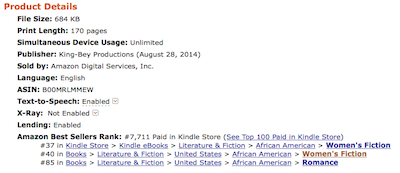
So how is it possible for a fiction e-book find its way in a non-fiction category?  Well when an author uploads their e-book onto Kindle and Nook, they are given the choice to place their e-book in up to three different genres that best describes their book’s content. If the author places their book into one or more genres you’ll see it listed on the e-book page in the book description area. You’ll also see where the e-book ranks overall and in the specific genres that the author has placed their book in. (Look at the example below). These “mistakes” aren’t an, ‘Oops, I accidently placed my book in the wrong category, gosh darn it!’ type of accident. This is more so like a ‘fake it ‘til I make it’ type of tomfoolery that some authors are using in order to make their numbers look better than what they actually are because many times the genre categories that the author chose to place their book in more than likely doesn’t generate many book sales, which makes it easy for the author to climb the bestsellers chart.

What can avid readers and book clubs do? Stop supporting authors that are cheating their way onto bestsellers lists! Even if you’re purchasing a paperback book take the time to click onto the author’s e-book page and see which genres they are placing their book into. Also, stop downloading cheap books unless it’s something that you KNOW you’re going to read. This will stop authors from being placed on the bestseller’s list when they haven’t earned it. If you see a book in a fiction and non-fiction genre, email the author and ask them why. The only books that are able to straddle both parts of the genre fence are autobiographies that are built on lies, which would make them fiction! J

What can the literary industry do? Create some type of price point for e-books per the size, just like traditional books have in place. This will help to separate the good from the bad. I think Amazon and Barnes and Noble should not allow authors to place any books in both fiction and non-fiction categories. Obviously, some authors don’t have the truth in them and simply won’t do right.

What should the fake bestselling authors do? Stop faking the funk and get your act together. Hard work pays off…not deliberate acts of deceit. If you’re truly a great writer, let your work be your weapon and stop being a weasel! You are a constant reminder of what’s wrong with the literary industry today. Because of you, “bestseller” doesn’t mean much to avid readers because we still have to sift through the bad apples to get to the great authors. So unless you can prove that you have earned a bestselling title on a list that actually carries weight…we don’t care. There are no shortcuts to success. The lessons that you’ve bypassed on your seedy path, while faking your way to the top is making you look like a fool and a cheat! Get it together so that we as avid readers will want to support you and help you build the right foundation for success as your fan before we have no choice but to give up on you altogether. You’ve been warned!

TaNisha Webb

If you found this post helpful, please use the Share buttons to spread the word about it.

Dee here: I wanted to take a second to congratulate TaNisha on the One Year Anniversary of her wonderful magazine, Book Club 101 Magazine. Every author interested in truly getting to know readers should be sure to read this publication. The electronic version of the Spring 2013 issue is FREE. Please spread the word.


Don’t have a copy of Become A Successful Author? What are you waiting for? Become A Successful Author is used in the “How To Write That Novel” course at Chicago State because it covers everything from branding to writing to editing to formatting and uploading electronic and print books to marketing and so much more. Your time is money. Look at all the time, thus money, you’ll save by ending your search for answers: Purchase Become A Successful Author for only $4.99 (eBook) or $9.99(print) from: Amazon (US), Amazon (UK), Barnes & Noble

Share

Busting Through the Block by Lynn Emery

Lynn EmerySome say writer’s block is a myth, a form of procrastination. Other authors insist it’s real, and they’ve suffered through it. As a therapist I’ve learned that if a person is convinced, it doesn’t matter if others say something is real or all in your mind. The bottom line is you need to work on the problem, whatever it is. Here are some tips to shock your unconscious muse back to life.

  • If you are blocked on what a character should do next or how they would react to a story event/plot turner go back and work on characterization. Chances are you need to flesh out more details on who she is- what are her goals, values, motivations, beliefs, etc. It might help to get to know her again. Most often hitting this kind of brick wall means you need to do more work on your character(s).
  • If you are blocked on what will happen next in your story (plotting), go back and review your story outline. O maybe you need to do one if you were writing by the seat of your pants. What story questions must be answered? What are the internal and external conflicts? What are the character motivations? What are the character goals? What is the dark moment when all seems lost? What is the climax (main characters must make a decision and take action)? What is the resolution? How are the main characters changed by this journey at the end?

Writing Exercises

To

Kick Start Your Brain


  1. Start a scene with your protagonist arriving or leaving some place in your story setting. Describe this setting through her eyes, including emotional reactions. Describe how secondary (or other major character) view the setting and the arrival of the main character using facial expressions, body language and dialogue. How does this affect the scene where you hit a block?
  2. Write a character’s worst moment, something that changed her or him in a basic way. Now write a scene where the effects of that event color how the character lives and now views the world in a way that affects your plot.
  3. Write a scene in which your character is arguing her viewpoint, some subject that she feels strongly about. This could be high concept (e.g. testifying before Congress, negotiating with a hostage taker) or discussing a subject with another character (relationship problem, family problem). Either way make the stakes high, in other words something terrible will happen if she doesn’t prevail. Throw in barriers that might keep her from prevailing. How does she overcome these?

Lynn Emery ©

If you found this post helpful, please use the Share buttons to spread the word about it.


Don’t have a copy of Become A Successful Author? What are you waiting for?Become A Successful Author will be used in the “How To Write That Novel” course at Chicago State because it covers everything from branding to writing to editing to formatting and uploading electronic and print books to marketing and so much more. Your time is money. Look at all the time, thus money, you’ll save by ending your search for answers: Purchase Become A Successful Author for only $4.99 (eBook) or$9.99(print) from: Amazon (US), Amazon (UK), Barnes & Noble


Share

How To Overcome Rejection: One Author’s Journey by Trice Hickman

Trice HickmanI’ll never forget the day I started writing my first novel. It was a chilly morning in March 2004, and after many years of suffering from writer’s block, I had a breakthrough! I sat in front of my computer and smiled in amazement as words began to pour out of me like sweet water. I wrote all day and all night and by the next morning, 30 pages later, the beginnings of my debut novel, Unexpected Interruptions, was born.

I was energized with a feeling I’d never had before. I continued to write nearly every day, and a little over four months later my novel was complete. What a great feeling that was! But little did I know that as difficult as I’d thought it was at the time, writing my book turned out to be the easy part. I soon discovered that the hard part was getting my book published. And harder still…selling it!

I conducted diligent research and then submitted my manuscript to every agent, publisher, and editor whom I thought might be interested in my well-written, wonderfully engaging story. Who could turn down my masterpiece, right? Well, imagine my dismay when the rejection letters started trickling in. Everyone I’d submitted my manuscript to turned it down. EVERYONE!

“Did they really read my story?” I’d questioned, “because if they had, how could they turn me down?” I’d asked, over and over, month after month.

Let me tell you, rejection is a hard pill to swallow, but it can also serve as a wake up call. There’s a saying, you haven’t loved until you’ve had your heart broken. Well, you’re not a writer until you get your first rejection letter. But I had some great things on my side that beats rejection every time: Belief, Determination, Perseverance, and Faith.

I believed in the story I’d written and the characters I’d created. I was determined to persevere and do what it took to get my book published, and I had faith that I could do it! Again, I did my research. I made it my mission to learn everything I could about how to publish a book. I attended literary conferences and networked with other authors. I developed a plan, created a timeline, and then I formed my own company, Platinum Books, and published Unexpected Interruptions myself.

The book that everyone rejected went on to win two literary awards, receive high praise from readers, and top a national book club’s bestsellers list. I went on to publish two additional novels that were equally well received. After the success of my books, a traditional publisher offered me a contract to re-release all three of my originally self- published books. The rest, as they say, is history! Oh, and did I mention that upon it’s re-release, Unexpected Interruptions, the little book that everyone initially rejected, received a starred review from Publishers Weekly!

As great as I think my personal triumph is, my story is not uncommon. There are many people just like me who’ve had a dream and didn’t give up until they achieved it. Every successful person I know has had to overcome some sort of obstacle or rejection. And like me, the thing we’ve all learned is that behind every no, there is a yes waiting for you, as long as you’re willing to put in the work!

Trice Hickman


If you found this post helpful, please use the Share buttons to spread the word about it.


Don’t have a copy of Become A Successful Author? What are you waiting for?Become A Successful Author is used in the “How To Write That Novel” course at Chicago State because it covers everything from branding to writing to editing to formatting and uploading electronic and print books to marketing and so much more. Your time is money. Look at all the time, thus money, you’ll save by ending your search for answers: Purchase Become A Successful Author for only $4.99 (eBook) or $9.99(print) from: Amazon (US), Amazon (UK), Barnes & Noble


Share

Author Etiquette 101: Mind Your Manners by J’son M. Lee

J'son M. LeeDesperate times call for desperate measures.  All of us have heard this phrase at one time or another.  In short, it means when people get into trouble, they feel forced to do things they wouldn’t normally do for survival.  Authors are no exception.  When it comes to our livelihood, most of us will do whatever it takes to sustain it.  Many of us draw the line when it means sacrificing our reputation or integrity; however, there are a number of authors who choose to stand their ground no matter the cost.  I am of the mindset that authors who want their books to be noticed will garner more fans and support by remembering their manners than by imploring tactics that may jeopardize their livelihood.

When an author spends months or even years developing a project, it stands to reason they want readers to take notice of their masterpiece.  However, just as bad parenting can ruin a child’s chance at success, authors can do the same for their books if they forget common courtesy.  It is important to respect those who impact your livelihood.  This list includes readers, reviewers, editors, and yes, even other authors.  Here are a few simple pointers for authors about proper etiquette:

Be Courteous to Your Readers

Everyone is not going to like your book, and as wonderful a person as you are, everyone is not going to like you.  Let that sink in for just a moment.  In most cases, those who fall in either category will be in the minority.  If we embrace this fact, we would realize there is no need for public outrage when we feel attacked personally or when we receive less than favorable feedback on our work.  It is not necessary to respond.  Brush it off!  This is easier said than done sometimes, but you must decide who you want to become and walk confidently in that path.  Let your fans fight your battles.  Remember that person who said how great you were?  How brilliant and thought-provoking your narrative was?  Yes, that person.  Let them handle the minorities.  Stick to what you do best – writing great prose.   If you’re going to be a professional writer, act like one.

Be Creative and Strategic

Just because you have the capability to reach readers 24/7, it doesn’t mean you should.  Talking about yourself or your book incessantly gets tiring.  How many ways can you say, “Have you read (insert name of book)?”  or “1 click (insert name of short story).”  At some point, you must realize that readers tune out or simply ignore your post.  It is human nature.  Stop blasting timelines and groups with your book advertisements.    Be a little more creative and strategic with the information you share.  Book groups have voiced over and over how they hate being bombarded with book advertisements.  So, why are you still doing it to the degree you are?  If it’s arrogance, you need to check that – NOW!  Your posts speak to your professionalism.  I would venture to say that most readers want a little more from you than a book link.  Share information that will spark conversation.  Readers really like to get into your head.  Give it a try!

Ultimately, if you fail to treat readers right, your work is in vain.  The business (yes, we are running a business) of writing isn’t as complicated as many make it out to be.  Remember the basic rules our parents taught us:  1) say please and thank you and 2) treat others the way you want to be treated.  It is really quite simple.  Treat your readers right and you will have the best, free marketing for life.  Treat them badly, and you will have a public relations nightmare.  When treated badly, readers will not tell others about the great book you wrote – no matter how great it is.  Bottom line, mind your manners!

J’son M. Lee

For more information about the author, please visit his website at http://www.jmccoylee.com/ or http://www.sweetgeorgiapress.com/.


If you found this post helpful, please use the Share buttons to spread the word about it.


Don’t have a copy of Become A Successful Author? What are you waiting for?Become A Successful Author is used in the “How To Write That Novel” course at Chicago State because it covers everything from branding to writing to editing to formatting and uploading electronic and print books to marketing and so much more. Your time is money. Look at all the time, thus money, you’ll save by ending your search for answers: Purchase Become A Successful Author for only $4.99 (eBook) or$9.99(print) from: Amazon (US), Amazon (UK), Barnes & Noble

Share

Lead With Your Strongest Info by W. Terry Whalin

W. Terry WhalinIt is something I learned early on as a journalist: your writing must begin with strength. What is the most intriguing question or strongest quotation or provocative sentence to start your query letter or your pitch to the editor or agent?

In pitches and proposals from unpublished writers, I often see critical information buried. As a reader, I know many agents and editors will never discover this information because they gave up after the opening paragraph.

Last Fall, I met an author with a strong gift book proposal. While Morgan James Publishing doesn’t produce this type of book, there are many well-respected publishers who make gift books. This author had something unusual in her proposal: a strong endorsement from a well-known author. Yet it was buried on the last page of her proposal.

I reviewed her pitch letter or query and while she referred to the endorsement, it did not contain any of the actual words. I suggested she start with a small portion of the endorsement because it would catch positive attention.

Here’s the critical fact that many people forget: agents and editors receive a high volume of submissions. They have many factors tugging for their attention besides submissions which makes them skim through the submissions making quick decisions about reading it in depth or rejecting it.

It’s always surprising to me what a little reorganization can do to strengthen a pitch. The quotation from the well-known author catches attention and pulled the editor or agent to take a more detailed reading of this author’s work. Something simple like this can be the difference between acceptance and rejection.

The first step for any writer is to get their material into the marketplace and in front of the editors. Many writers are missing this critical step and not taking action to send out their work.

If you are taking this step and collecting a number of rejections, I suggest you take a fresh look at your pitch or query. Ask a few questions:

  • Do I have the strongest material in my pitch in the first paragraph or the first sentence?
  • Can I read my pitch with fresh eyes and see how the editor or agent is reacting to it?
  • Am I missing something critical that I’ve left out of the package? One of the most difficult things to see in your own work is something that is missing.
  • Can I add an endorsement or provocative quotation or something to get additional attention?

There are many other methods to gain the editor’s attention but these questions will give you some direction in this area. In our busy world, the writer has to take action and lead with their strongest information.

If you make these changes, write me and let me know how it worked out or helped you. I’m always eager to read your comments and feedback.

________________________________________

W. Terry Whalin, a writer and acquisitions editor at Morgan James Publishing, lives in Irvine, California. He has written more than 60 nonfiction books including Jumpstart Your Publishing Dreams. His website is located at: www.terrywhalin.com.

If you found this post helpful, please use the Share buttons to spread the word about it.


Don’t have a copy of Become A Successful Author? What are you waiting for?Become A Successful Author will be used in the “How To Write That Novel” course at Chicago State because it covers everything from branding to writing to editing to formatting and uploading electronic and print books to marketing and so much more. Your time is money. Look at all the time, thus money, you’ll save by ending your search for answers: Purchase Become A Successful Author for only $4.99 (eBook) or$9.99(print) from: Amazon (US), Amazon (UK), Barnes & Noble

Share